Monday, July 16, 2012

Chasing Ghosts in Haunted Canyon

July 9, 2012 © Thomas J. Kollenborn. All Rights Reserved.
There is an old Indian story about Haunted Canyon. It’s a tale about where the sun introduces the sky to the wind. When the sun hides and the sky becomes dark, the wind blows through Haunted Canyon calling to the dead.

My friends, that is enough of a ghost story told to me by an old Apache many years ago while he was gathering Jojoba nuts in Haunted Canyon. The story convinced me Haunted Canyon was important to the Apache. Bear grass, agaves, jojoba, pinyon and acorns can all be found in the canyon. These were all staples for the Apache at certain times of the year.

Haunted Canyon has eroded down through a thick layer of limestone making the region susceptible to solution caves. These caves are often small and found high above the canyon floor. One large cave just below the old Toney Ranch goes deep into the mountain.

Many years ago a rancher found a skeleton of a bear in the cave. The cave was filled with stone arrowheads, again attesting to the use of the canyon by the Apache or other early inhabitants of the area.

I visited Haunted Canyon for the first time in 1968. It was still a very primitive area and difficult to penetrate on horseback or afoot. Once into Haunted Canyon one finds the brush along the canyon floor very thick and difficult to see through. Oak, juniper and sycamores are common along the canyon floor.

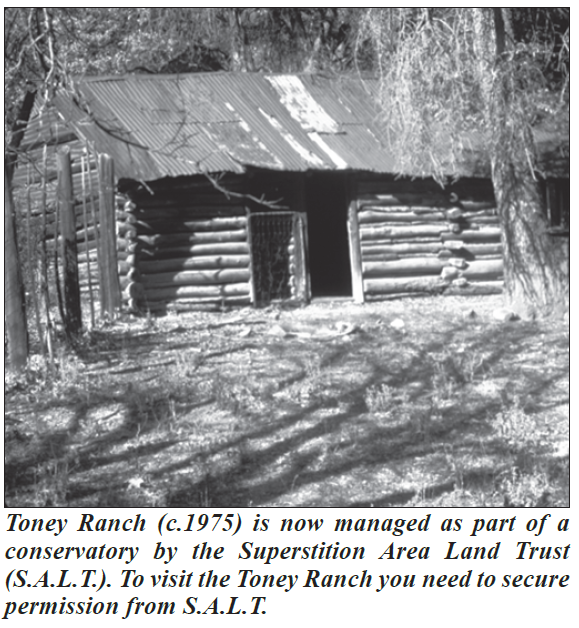
We set camp about a hundred yards from the old Toney Ranch cabin. This chinked log cabin with its corrugated metal roof stood out among the sycamore trees in Haunted Canyon. At the time the old ranch was not occupied, but we chose not to stay in the house because of the mice, scorpions, black widow spiders and what ever else occupied the dwelling.

As the sun slowly fell below the western horizon the air began to cool. The sounds of the night filled the air. At first we heard the crickets; than an occasional frog, all of this was followed by a pair of serenading coyotes somewhere up the canyon from our campfire. We sat around the fire talking about chasing cattle and working on such a desolate ranch in the Superstition Mountain area.

We repeated the story of the “cave with a thousand eyes” and talked about how a man named Pete Moraga found this cave around 1900. We also told the story about another man named Perez who thought he found the Lost Dutchman Mine when he found the same cave in 1917.

Then there was the story of Modoc and his lost diamond mine in the Superstition Mountains. Modoc reported his find to the Mesa Journal-Tribune in mid 1930’s. The story was short-lived when everybody found out the diamonds were calcite crystals.

There is even another story about lost gold in Haunted Canyon. Old man Kennedy allegedly had a hidden gold mine somewhere in the area of the canyon. Kennedy would show up in Superior or Globe periodically with a large quantity of placer gold claiming it came from his mine in Haunted Canyon. Nobody has ever found placer gold in Haunted Canyon, but they have found placer gold in Gold Rush Creek, a tributary of Pinto Creek. Today Gold Rush Creek is gone and in its place is an open pit mine.

Many years ago the area was  filled with wild cattle and in 1968 there were still a few in the area. About the only way the old time cowboys could work cattle in this brushy nightmare of a range was with cow dogs. Years earlier I had ridden into this country with a friend looking for deer. After a couple of days riding the brushy tributaries of Haunted Canyon I was ready to return to the desert.

Cowboys who busted through this chaparral were called ‘brush whackers’. Cholla cacti are notorious on the desert, but Manzanita is worse. Broken Manzanita is brittle, very sharp and extremely hard. It is so hard it can easily pierce heavy work chaps, boots, even a horse’s hide or a cowboy’s leg.

Setting around a campfire helps conjure up ghost stories and tales about mysterious occurrences. This night was no exception around our campfire in Haunted Canyon. It wasn’t long before somebody was talking about the Apaches and some of those stories about Haunted Canyon. There was one story about an old prospector who was captured by the Apaches and hung upside down over a bed of hot coals just eight inches from the top of his head. This was one of the slowest and cruelest ways the Apaches killed their captives.

Time was always on the side of the Apache. As the old man dangled from a piece of rawhide he kept pulling his head from side to side trying to avoid the heat of the coals that were slowing baking his
skin and brains.

According to the storyteller, the sun introduced the sky to the wind. The wind soon brought heavy dark clouds. Lightning streaked through the sky and the thunder roared. Heavy rain began falling and the coals were soon extinguished. The sound of thunder, wind and rain made the Apaches abandon their helpless captive without further harm.

The rawhide began to loosen as moisture once again returned to it after the heavy rain. Somehow the old prospector was able to escape his bounds and return to Globe and tell his story.

Over the years I have returned to Haunted Canyon on several occasions and found the area undisturbed. I suppose the old ranch house has survived because of its isolation.

The last trip I made into Haunted Canyon was in the mid 1990s when I heard the area might be destroyed or impacted by a large open pit mining operation scheduled to begin operation in the area to the east.

The legacy of Haunted Canyon is filled with many interesting and fascinating stories. Today, the old Toney Ranch and property are under the conservatory of Superstition Area Land Trust and is protected. One needs to secure permission to hike into the old Toney Ranch, however Haunted Canyon is open to exploration.

I wouldn’t recommend trips into the area except from mid-October to the end of April. The summer months can be hot and water is extremely limited in the area.

Author’s note: There are articles about the Toney Ranch, the Cave of a Thousand Eyes, and Haunted Canyon, the Lost Modock Diamond Mine and others in years past. The Apache Junction City Library
may have copies of those stories available to read.

Monday, July 9, 2012

Arizona's Monsoon Season

July 2, 2012 © Thomas J. Kollenborn. All Rights Reserved.

According to legend and myth the great “Thunder God” roars during the summer months in Arizona. Many of us do not find this hard to believe if we have experienced a severe and violent desert thunderstorm during the summer monsoon season. The lightning, thunder and winds will convince the nonbeliever these storms can be dangerous and violent.

During the summer months most of the storms over central Arizona and the eastern portion of the Superstition Wilderness Area result from warm moist air flowing in from the Gulf of Mexico and sometimes from the Sea of Cortez (also known as the Gulf of California). As this air mass moves across Texas, New Mexico and Mexico it is dried out some. Mountains force the warm moist air upward forming clouds that eventually release their moisture as they rise. This is known as “orographic life.”

These massive anvil-shaped thunderhead clouds that form over Superstition Mountain from July to September normally combine both orographic lift and convectional activity together. Convectional storm clouds result from the rapidly rising and expanding warm moist air and the rapidly falling cold moist air. It is during this convectional activity that lightning is generated. The uneven heating of the earth’s surface causes convectional activity in the atmosphere.

Lightning can be caused by the attraction of unlike electrical charges within a large storm cell. The rapid movement of ice and water molecules, going up and down in a  thunderhead cell, creates friction that results in enormous amounts of static electricity being produced. A single lightning discharge can produce about 30 million volts at 125,000 amperes. A discharge can occur in less than 1/10 of a second. The results of a lightning strike can be horrific.

The rapid rising and falling of warm and cold moist air also creates violent bursts of energy. This type of storm activity can result in microburst. Microbursts can develop winds that momentarily reach up to 200 mph. As the clouds build and combine they form massive anvil-shaped thunderheads called Cumulonimbus clouds. These clouds are massive static generators dispersing lightning and creating violent  winds. These summer storms can be extremely dangerous and violent.

It is these giant thunderheads that dominate the sky above Superstition Mountain during the monsoon season and the lightning produced by these storms over Superstition Mountain can be spectacular.

According to most sources, the safest place during a lightning storm is in a nongrounded automobile. Don’t make yourself part of a lightning rod during an electrical storm by standing by a lone tree or on a high point. The use of your telephone during an electrical storm could be your last conversation, depending on the circumstances of a lightning strike. The same is true when connecting to the Internet.

Standing near or in a swimming pool is asking to meet your maker sooner then you expect. Boating on a lake during an electrical storm is certainly risky behavior on your part. This kind of activity could certainly reduce your chance of living to an older age. Common sense needs to prevail during severe thunder and lightning storms.

Most Arizona monsoons storms are associated with two other dangerous conditions. They are flash floods and dust storms. A thunderstorm can dump three to ten inches of rain over a small area in an hour and create a massive flash flood. A flash flood near Payson, Arizona in the 1970s claimed the lives of 22 campers along Christopher Creek. Many years ago I witnessed a 4-foot wall of water roaring down Queen Creek claiming trucks, horse trailers and horses. This flash flood result from a thunderstorm in the mountains and nobody saw it coming.

Huge dust clouds are often associated with Monsoons storms in the desert. Local weather reporters often refer to our dust storms as “Haboobs.” Egyptian dust storms that blow in from the deserts of North Africa are known as Haboobs.

Dust storms are extremely dangerous to vehicular traffic. Extreme caution should be taken when dust storms are encountered. It is recommended that motorist pull as far off the highway as possible and turn off your lights. While waiting a dust storm to blow over don’t rest your foot on the brake pedal. Your taillights or brake lights might attract drivers in the storm who might think they are following you.

If you’ve ever witnessed a violent electrical storm over Superstition Mountain, it is not difficult to see why the early Native Americans held the mountain in such awe. We can partially explain the phenomena today with modern science, but the early Native Americans could only look to their religious shaman for an explanation.

It certainly was their “Thunder God” with all it fury. We as late arrivals should also respect the awesome power of their “Thunder God.”

Monday, July 2, 2012

The Search for Gold

June 25, 2012 © Thomas J. Kollenborn. All Rights Reserved.

Man has searched for gold for thousands of years. It is a very soft and inert metal that is easy to work. Gold is also one of best conductors of electricity, explaining its use in electronics. One ounce of gold can be stretched into a fine wire some thirty-five miles long proving the extreme ductility of this metal. Gold can also be pounded into sheets so thin you can see through them again attesting to its malleability. This particular property allowed gold to be used for gilding over other materials such as stone, silver, lead, wood, clay, and many more. This property alone could explain huge gold statues that once existed in primitive civilizations or cultures.

The malleability of gold might explain the many tales of enormous golden statue in various civilizations of the world. Man continues to search for gold in the Superstition Wilderness Area believing the age-old stories of those who searched before them.

Seldom does a year go by that someone doesn’t claim they have found the Dutchman’s Lost Gold Mine in the Superstition Mountains. Of course nobody has produced any gold to substantiate these claims. The storyteller usually makes such claims as the gold had been removed before they found the site. Searching for gold in the Superstition Mountains has become primarily a solo vocation for those who are serious Dutch Hunters and not con artists.

We have our share of Dutch Hunters who continue to search for the Dutchman Lost Mine year around in this truly forbidding and sometimes dangerous land. The prospector or treasure hunter contends with completely different elements than the average adventurer or hiker.

The hiker travels on foot from one place to another. If they are a photographer they will always find a host of subjects to photograph in the Superstition Wilderness Area from landscape to wildlife. The prospector or treasure hunter is usually off the wellbeaten path looking for special clues that might lead to cache of gold, treasure or fit a special secret map. Most of them are trying to solve puzzles or riddles that have been created by those who have gone before them. They also study old and modern maps looking for clues that might guide them to their pot at the end of the rainbow.

Many prospectors and treasure hunters are somewhat paranoid about the dangers that lie ahead of them in the wilderness. They sometimes fear fellow prospectors or treasure hunter who might be following them to garnish information from their research.

Many prospectors and treasure hunters are heavily armed. They fall into three or four main categories. Prospectors are generally looking for placer gold or gold lode. They try to adhere to geological principles or apply common knowledge of known ore deposits in a given area. There are no known ore deposits within the Superstition Wilderness Area. Recent United States Geological Survey work indicates there might be deep-seated mineralized areas below 5,000 feet beneath the Superstition Wilderness Area.

There are also prospectors who believed Jacob Waltz, the alleged Dutchman, had a very rich gold mine located in the Superstition Wilderness Area. More than one hundred and fifty years of prospecting has not produced any substantial amount of gold. This in itself should be testimony enough that no rich gold veins lie near the surface within the wilderness. The continued search for the Dutchman’s Lost mine is total futility. The existence of a mine is the figment of many people’s imagination.

Now we must consider those who are constantly promoting ridiculous ideas that a rich gold deposit can be found if only the puzzles of several maps or the Peralta Stone Maps can be solved. We don’t want to disappoint you, but it’s apparent that most treasure hunters are in their own world. Most of the people who search for gold in the Superstition Wilderness Area enjoy an adventure. None have been successful in finding gold, but most have found beauty, peace, isolation and tranquility in the deep canyons and towering spires of this rugged mountain range.

There are a few people who search for gold who are paranoid and talk about Apaches that stalk prospectors and treasure hunters. They speak of Apaches that guard ancient ancestral burial sites. The Apaches have little real use for a place like the Superstition Wilderness Area. The only Apache I ever saw in the Superstition Wilderness Area between 1955-2010 were cowboys that once worked for Floyd Stone on the  Tortilla Allotment. Elmer Pope was an Apache cowboy from San Carlos, Ariz. He was only interested in horses, cows and payday.

In the end the search for gold in the Superstition Wilderness Area is nothing more then an adventure with your friends. The existence of gold in the Superstition Wilderness Area is highly unlikely. When you wander the trails of the wilderness hoping to find gold, however in the end it is nothing more than a memorable experience.

To quote my dad, “Today’s memories were yesterday’s adventures.”