Monday, December 10, 2012

My Silver Screen Heroes

December 3, 2012 © Thomas J. Kollenborn. All Rights Reserved.

Times were tough in the late 1950s. My dream to attend the university vaporized after my first semester.

Well, who needed a university education? I had neither the ambition nor resources at the time. I was convinced I wasn’t intelligent enough to claw my way through eight semesters of classes at Arizona State Teacher’s College. So I gave up this goal. My second goal in life was to be a cowboy and it was far more desirable.

The old Quarter Circle U Ranch served as my introduction to manhood and making my own living. No longer would I be dependent on the folks at home. Often my checks were so small they didn’t even cover the bare essentials. That was OK with me. I was going to be a cowboy. My drive to accomplish this goal out-weighed my common sense, if I had any at the time.

I sold and traded all my precious childhood possessions and depleted my meager bank account to purchase a saddle, chaps, spurs, headstall, bridle, bit, reins, saddlebags, and a good 35-foot 3/8” nylon rope. My father and mother bought me a change of Levi shirts and pants. At the time I had a worn pair of Tony Lama boots.

I acquired all this tack without even a horse to ride. Barkley had not assigned me a remuda of horses to work with. Eventually I was given three head of horses to use. They were named Scooter, Sorrel, and Spook. All three mounts made an impression on me in one way or another.

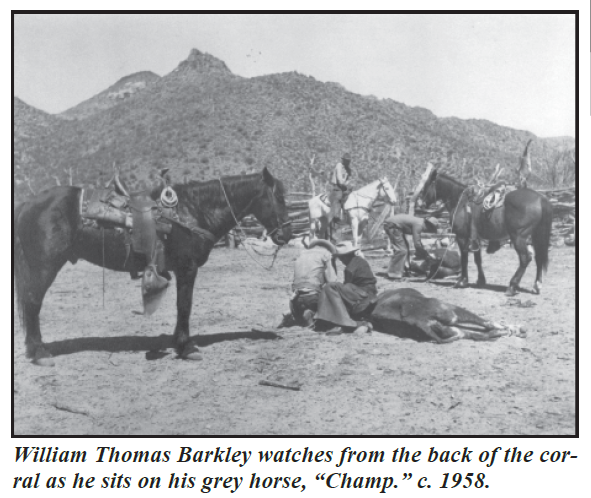
Man, can I remember the first day I saddled up for my boss, William Thomas Barkley. I had carefully observed him during his saddling ritual every morning for almost a week. Never once did he ask me to saddle up and accompany him on the range. Finally one morning he looked at me and asked, “Are you ready?”

I tried to remember his saddling routine to the finest detail. First, he checked the horse’s feet to see that the hoof was clear of manure, gravel, small rocks and any other debris that might injury the horse’s foot. Using a hoof pick, Barkley ceremoniously cleared each hoof of debris. This was followed by careful examination
of the horse’s back, withers, and barrel for sores or injuries. After this careful examination, Barkley would then curry and follow by a though brushing. Barkley then placed a smooth blanket on the horse’s back, followed by a thick saddle pad.

Curried, brushed, and padded the horse was ready for his old Kaiser low-roper saddle. As Barkley picked up his saddle you could hear the well oiled leather creak. In one smooth motion he placed the saddle on the horse’s back. He carefully centered and adjusted the saddle to fit the horse’s back and withers. Barkley rode his saddle high upon the horse’s withers.

He then gathered in the cinch D-ring and pulled the latigo through. He checked his cinch to make sure it wasn’t twisted. With a few quick motions he was ready to cinch up his horse and tie off.

Next came the breast strap. He then tied his 45-foot nylon rope on his saddle that he used for groundwork. A canteen and saddlebags completed his saddling ritual. The final step was removing the nosebag and placing the headstall and bit in the horse’s mouth.

Barkley’s old horse Champ had a particular dislike for a cold bit. Bill would warm the bit for a few minutes with his hand before placing it in his horse’s mouth. This simple act convinced me Barkley loved his animals. The buckling of the throat strap ended the morning saddling routine.

He looked over at me and asked, “Are you ready?” At that moment I started a repeat performance of his routine. He watched me like a teacher watches and guides his or her students. He then called out to me, “Hey Slim let’s go. we’re burning daylight.”

The first day I was just trying to keep up with the man I now believed to the “King of the Cowboys.” I had envisioned a cowboy to be something entirely different than what I saw before me on that cool spring morning at the old Quarter Circle U Ranch.

No silver-studded saddle, no fancy chaps, no Winchester in a saddle scabbard, no fancy Western shirt and most of all no six-shooter on his hip. This was just a plain old cowboy who worked range cattle.

Barkley’s dress and demeanor was just the opposite of what I expected. He wore a sweatstained  denim shirt, pants, gray Stetson and a plain pair of Tony Lama boots. His skin was tanned and wrinkled from years of working in the desert sun. He face revealed the lines of hard work and hard times. He was a man of the desert range.

“Just a real old cowboy,” I thought as we rode off toward Coffee Flat to check on some of his stock. William Thomas Barkley was a cattleman following in the footsteps of his father William Augustus Barkley who settled on desert with his wife Gertrude in 1907.

If you travel to Gold Canyon, East of Mountain View Road, north to the Palmer Mine, and on to Canyon Lake and on east to Peter’s Mesa you are on the old Barkley Cattle Ranch. At one time the ranch encompassed one hundred seventeen sections of private, state and federal land.

I worked at the old Quarter Circle U Ranch during its twilight years as part of the Barkley Cattle Company. We rode the entire 117 sections of land packing salt, doctoring cattle and rounding up stock. By 1970 the Barkley Ranch no longer existed.

Today Chuck and Judy Backus own the Quarter Circle U Ranch and run cattle on state lease land. The Backuses are making an attempt to keep the history of the old Quarter Circle U Ranch alive. I certainly do admire them for doing that. As I look back at my experience on the old Quarter Circle U Ranch I had found the true silver screen hero of the West in William Thomas Barkley.

Monday, December 3, 2012

Riding With Buck Wallace

November 26, 2012 © Thomas J. Kollenborn. All Rights Reserved.

Many years ago when I worked on the old Quarter Circle U Ranch in Pinal County I heard many a wild yarn. The storytellers would occasionally gather on the porch of the old bunkhouse on a hot summer evenings and the tall tales would begin. Usually the group was a mixture of cowboys, prospectors and sometimes an occasional deputy sheriff, brand inspector or game warden.

One hot July evening Bill Finch, the state brand inspector showed up about sundown. He wanted to throw his bedroll down and spend the night on the porch. Bill always had his guitar with him to serenade himself, the cattle and his horse. This particular night Buck Wallace, state game warden, was also spending the night. Buck also packed a guitar and a harmonica. Added to the group that night was also an old prospector named Joe Roider who played the spoons. Now add a cowboy and a greenhorn to this mixture and you really had a tall story brew.

The Black gnats and mosquitoes were biting and aggravating everyone. We put out a smoke pot filled with some kind of insect repellent that discouraged the insects a little, but just about suffocated us. I would guess it was about 98 degrees that evening as we sat singing and talking about the Old West and lost gold mines. Today, I believe I am the only survivor of that group. It was certainly one of those unforgettable evenings considering the circumstances.

As I recall the moon was full, and coyotes were howling, Bill Finch was singing “the Streets of Laredo,” Joe was playing the spoons, Buck was playing his guitar and harmonica and the rest of us were singing along. The night slowly began to fade away as the Coyotes howled and serenaded us.

I remember the group giving their opinions as to whether or not the old Dutchman’s mine existed and if it did— where? Then there was a story about a dead elk in the back of a pickup with mule shoes on it. As it turned out some dude hunter shot a mule thinking it was a cow elk. This discussion continued into the early hours of morning, never being any real agreement. When the disagreements got out of hand Bill Finch would start another song and play his guitar. Rather than argue everyone would join in playing and singing along with Bill Finch.

This was my first introduction to Garland Ellsworth “Buck” Wallace. Buck was a kind of man who was always on duty. It was after this get together Buck and I got acquainted. We made several rides together that winter into the Superstition Mountains.

Buck and I had spent several different occasions riding the mountains when the weather cooperated and sometimes when he was checking in on all the hunting and prospecting camps. I knew what Buck was looking for and I rode along with him. My boss wanted to be sure nobody was rustling any of his cattle and he encouraged my participation with Buck. I always enjoyed talking to this man. He was dedicated to enforcing the game laws in Arizona and preventing poaching. Buck in many ways was one of the few men I met that maintained my belief in the sliver screen cowboys that were heroes as a child. He was tall and slim and always clean cut. He wore a Stetson, Levis, pearl button Western shirts, always had his belt on that had his name “Buck” carved in it and of course cowboy boots. He always challenged me to do better in life. At the time all I wanted to do was become a good cowboy.

Whenever Buck visited the ranch I just volunteered to open our Serval refrigerator and freezer and let him have a look. The truth was I preferred beef instead of venison any day and Barkley always had plenty of beef on hand for us to eat.

On one beautiful day Buck and I rode over to Piper’s Camp at the base of Weaver’s Needle. I rode into camp ahead of Buck and greeted everyone. Buck would visit with the individuals in camp and look around. After his inspection we rode on to the next camp. This particular day Buck and I checked out four camps. All of our stops were peaceful in nature and we had no problems. After inspecting the camps we made our way back to the Quarter Circle U Ranch.

I will never forget how proud Buck was of his one-eyed Buckskin horse named Pard. Buck would tell me there was nothing Pard couldn’t do with one eye that a horse with two eyes could do. One day he talked me into a short horse race to show Pard’s  ability. Another time he told me how Pard saved his life in a pinch. A limb had knocked him out of the saddle and he was hanging over a cliff hung up in his rope on the side of his horse. Pard stood perfectly still until he was able cut the rope with his boot knife and free his leg.

The stories on the porch that night about the mountains and prospectors reminded me of what life had been like being associated with this mountain and those who called it home. Calling the mountain home was like calling it a special place to visit and regain one’s composure and continue on with life. That night on the porch of the old Quarter Circle U Ranch we recharged everyone’s mind about what was real and what was legendary. Buck Wallace, Bill Finch, Joe Rodier, and Mike Finley were real people in a world of pretenders. The spirit of the West lives in the memories of men like Garland Ellsworth “Buck” Wallace and old Bill Finch. I am a better person for have knowing them both.

Buck Wallace passed away August 8, 2012 at the age of 99. He was a Navy Seabee during World War II. He had worked for the Arizona Fish and Game Department as a warden for twenty years. He was a life long member of the Masonic Temple. Buck was a good man and he believed in helping others. I was proud to have known and ridden with him in the Superstition Mountains back in the late 1950’s. I had found one of my silver screen heroes in Buck Wallace. He was one of those heroes who represented ethics, honesty, integrity, respect and compassion. Today, my friends, we need more people like Buck Wallace.

Monday, November 26, 2012

Earning My Spurs

November 19, 2012 © Thomas J. Kollenborn. All Rights Reserved.

As the first rays of sun light ventured across the summit of Miner’s Needle it was time for another day’s work at the Quarter Circle U Ranch. Usually we were already up and feeding livestock by dawn. Breakfast had been on the stove for 15 minutes when the feeding and watering was completed. Eggs, spuds, beans, chili, beef, bacon, biscuits, and coffee were a solid breakfast for hard-working cowboys. Soon we were saddling our horses for a long day’s ride into the backcountry to check and work cattle.

The call of the quail and a distant serenade of the coyotes were music to our ears as we rode east from the old URanch toward Castle Rock. This towering outcrop of rock east of the ranch looked something like a medieval castle, hence the name Castle Rock. The clinging of our horse’s shoes was mixed with the early morning sounds of the desert. A serenade only a cowboy could appreciate. The green- and yellow-blossomed Palo Verde trees were like burning torches from the light of the early morning sun. We could hear the distant bellowing of a calf for its mother. One of Barkley’s range bulls was rutting and sounding his call.

The trail that lay ahead was steep, rocky and difficult to follow. We arrived at Miner’s Needle Summit with near exhausted horses. As the air temperature warmed we rested our mounts in what shade we could find and adjusted our cinches. We then stepped into our stirrups and back into the saddle for the ride that lay ahead. Slowly we moved our horses toward Bluff Springs corral and cabin. We stopped briefly at a seep and watered our horses. Once we arrived at the corral we opened the gate and checked our supplies in the cabin. We then rode eastward looking for signs of range stock.

Two draws to the east we found about 12 head of cows and calves that needed to be moved back to the corral and checked for screw worms. It was always easier to work cattle in a corral then on open ground in this rugged country. After all we were not expert open ground ropers, especially with all the Mesquite, Palo Verde, Jojoba, Chain Cholla, Prickley Pear, Hedgehog, and Teddy Bear Cholla in the area.

We moved the cows and calves toward the corral without incident. Once they were in we began the task of checking each animal. Some were easy to check and others were not. This required plain hard work and our only tools were a primitive corral, gloves, a rope and a good horse. We roped, handled and doctored each animal. The final tally was 14 cows, 15 calves and two yearly steers. The mother cows we only visually inspected. Two of them we did have to throw and doctor for screw worm infestation. This endeavor required most of the day. We were pleased to know we had eased the misery of these cattle by treating them for screw worms. Our accomplishments were part of the routine of being a cowboy in these mountains. This was Barkley’s first year being involved with the Screw Worm Eradication Program. Almost everywhere we rode on his range we put out sterilized flies in small boxes.

Barkley always told us this was the roughest cow range in Arizona as far as he was concerned. We often rode crosscountry over huge rocks, slide areas and steep slopes to round up cattle. A steep slope was often 45 or more degrees. It wasn’t uncommon for a cow pony to take a spill with you. Many times my horse’s legs would just buckle under me and we would go down. A good cowboy gets his legs out of the way before the horse hits the ground if he is lucky. An unfortunate cowboy breaks a leg or a foot and is laid up for a couple of months or so. A smart cowboy stays out from under his horse under all conditions.

Ranchers don’t like to feed cowboys with broken legs or arms. Sometimes a horse will go end over end on a down hill slope because of loose or soft ground and a steep slope. Sometimes a saddle-tree will get busted, but a good cowboy steps clear with a little luck. Sometimes a wild cow will jerk your horse out from under you in rough country once you have tied on to her with your rope. I was one lucky novice cowboy on the Barkley spread and I knew it.

Somebody ask me about the trails one time. My response, “what trails?” Most of our range riding was over rugged terrain often where no horse had gone before, only a cow. The landscape was covered with thorn brush and Cholla cactus just to aggravate a cowboy.

Cattle will go anywhere to find water or feed. A cowboy has to be able to follow and coax them down out of the rugged terrain where they have sought browse. If cattle have plenty of feed and water in a rugged area they will remain until one or the other is exhausted. During roundup (rodeo) these cattle can be difficult to manage and remove from a rough mountaintop.

There are many such mountains in the Superstition Wilderness. If the rocks, slide areas, and steep slopes aren’t enough to discourage a cowboy, there are always the many thorny plants that stick and slash at your legs and arms as you ride through them. Most smart cowboys invest in thick, heavy leather leggings called Chaps. Usually these leggings add another ten pounds to your horse, but will save you several pounds of flesh. The weight your horse carries in rough country can be extremely important for your survival. An overburdened horse falls easily. These sudden falls tend to break a cowboy’s bones.

Old Gus Barkley always said everything in this desert either sticks, bites, stings or eats meat. Believe me these were prophetic words from a great philosopher who knew what he was jawing about.

When the Saguaro cactus begins to bloom the Black gnats swarm. These nasty critters love to bite man and beast alike. After a little summer rain you have the combination of Black gnats and Mosquitoes biting at your hide, both day and night. Just another pleasure a cowboy is subjected to while working on this range after a summer monsoon.

Rattlesnakes, scorpions, tarantulas and centipedes are nothing to fear. Common sense usually takes care of any encounters you would have with these critters. These creatures are the source of many good stories for cowboys to tell “dudes.” A smart cowboy is more concerned with the desert sun and the heat it produces. Cowboys who work in the summer months on the desert wear very wide brim hats and a large scarf around their neck for protection against the sun’s rays. Amazing as it may be, it is always cooler upon a horse’s back then walking on the ground. My guess is the temperature is a least 10 degrees less on horseback.

Our work at the corral ended just about sundown. We tightened our cinches and began the long ride back to headquarters. We knew dinner would be late, but we got a lot of work done and felt we had relieved the misery of a lot of cattle.

We arrived home long after dark. We fed what stock we had in the corral, cooked dinner and went to bed. Our well deserved rest for the night was appreciated, but usually interrupted by a damn coyote or fox in the barn chasing the chickens. We are up again at 2 o’clock in the morning chasing after a coyote, skunk, or fox. If we weren’t guarding the chickens, doctoring animals, or fighting the Black gnats, mosquitoes, scorpions, ants, and snakes then we could get some sleep.

This was just one day of my life on the Quarter Circle U Ranch. Barkley always said, if you can survive a year on this ranch you have “earned your spurs.” I was so dog-tired and exhausted I just couldn’t get too excited about Barkley’s cowboy spun humor or philosophy. However I knew it was the gospel of cowboy tradition in the Superstition Mountain area.